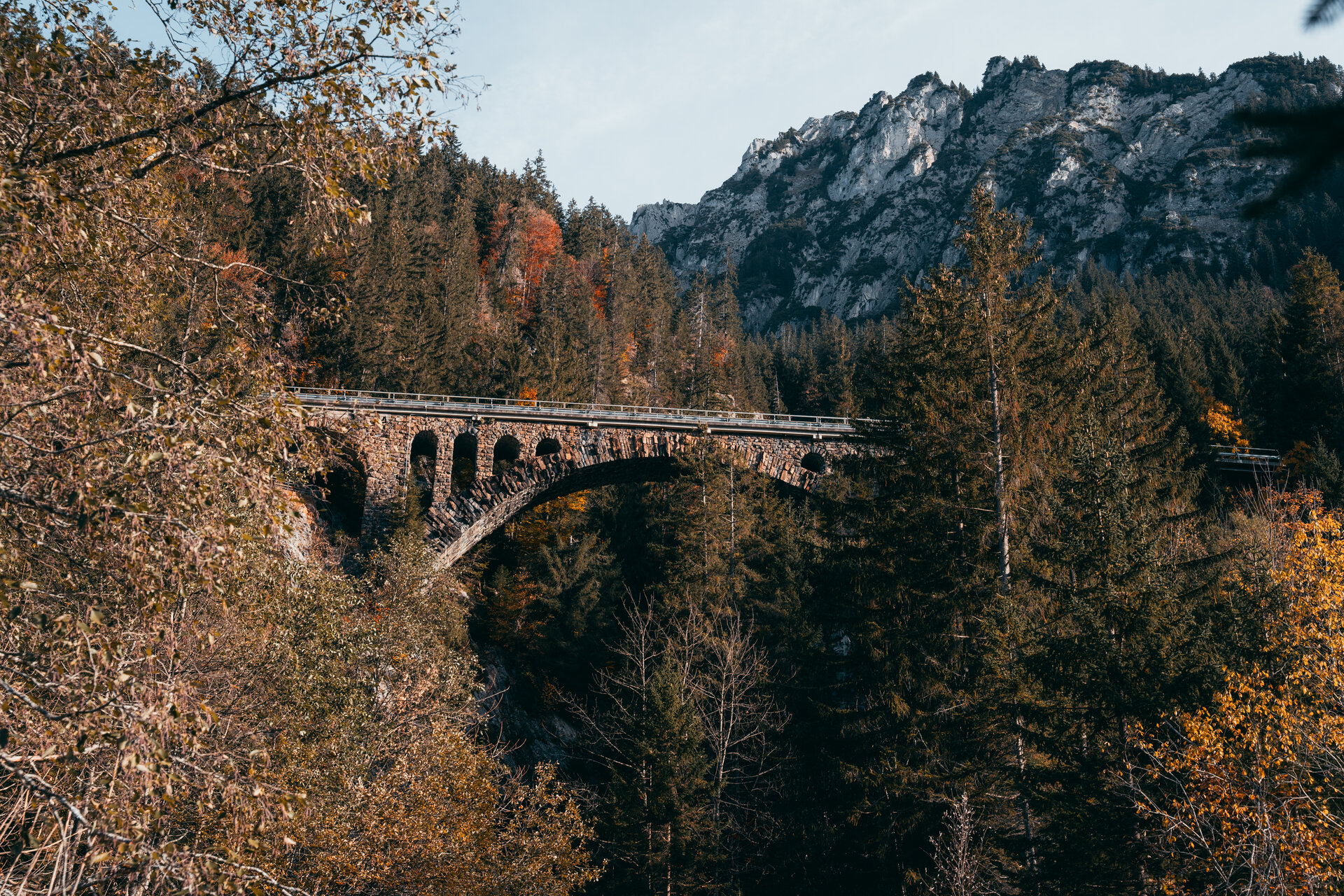
Wäldletobel: Traffic over the Arlberg
Despite the improvement of the trails, crossing the Arlberg remained particularly dangerous in winter. To provide assistance to travelers in distress, Heinrich Findelkind built a shelter on the Arlberg in 1386, modeled after other Alpine passes. In the first seven years alone, he and his helpers were able to save the lives of 50 people.
A Key Factor in the Development of Settlements in the Klostertal
Since time immemorial, the present-day municipality of Klösterle has been closely linked to traffic across the Arlberg. Customs posts, inns, and the work of pack animals and carters—as well as “snow breaking”—were key elements of economic development. The expansion of traffic across the Arlberg led to the establishment of the monastery mentioned in the document from 1218. Conclusions regarding Arlberg traffic and settlement pioneers prior to this period can only be drawn based on archaeological investigations. It stands to reason that the attention the Arlberg received from the 13th century onward led to an increase in traffic and the expansion of the route. New salt deposits were discovered in Hall during that time, which boosted the salt trade and east-west traffic. An expansion of the Arlberg route and the first collection of tolls are mentioned in 1312.
This medieval road across the Arlberg was partially uncovered during archaeological investigations between 2005 and 2008, as well as in 2011. Today, a hiking trail follows the historic route.
Despite the expansion of the roads, crossing the Arlberg remained particularly dangerous in winter. To offer aid to travelers in distress, Heinrich Findelkind built a hostel on the Arlberg in 1386, modeled after other Alpine passes. In the first seven years alone, he and his helpers were able to save the lives of 50 people. To complete the hospice and build a chapel, alms collectors were sent out to raise funds. Starting in 1393, the benefactors were recorded with their coats of arms in dedicated coat-of-arms and messenger books, three of which have survived. Pope Boniface IX, along with numerous bishops, supported the collectors and issued a letter of indulgence in 1398. Contrary to popular belief, however, there was no brotherhood (“fraternitas”) dedicated to St. Christopher in the Middle Ages.
The carriage road over the Arlberg existed until around 1500 and then reverted to a mule track because the route over the Fern Pass was increasingly preferred. In the following centuries, traffic over the Arlberg declined, although mule traffic remained of considerable importance. In Klösterle, the so-called “Wartesstall” served as a reminder of this era of pack animal traffic across the Arlberg until its demolition a few years ago. Another task for the residents of Klösterle and Stuben was the so-called “snow breaking.” As far back as the Middle Ages, the route across the Arlberg was kept open in winter whenever possible. When avalanche conditions permitted, a route accessible to pedestrians, pack animals, and sleds had to be cleared. To fund this, a so-called “Bruchgeld” (snow-clearing tax) was collected in Klösterle and Stuben.
Until the second half of the 18th century, the route over the Arlberg remained in poor condition. All efforts to improve it had been unsuccessful up to that point. It was not until Emperor Joseph II took an interest in upgrading the Arlberg Road for political and military reasons. During his reign, a corresponding project was drawn up in 1782, and by 1785 the road had been repaired to the point where it was passable by carriage throughout. Above Stuben, a new route was created through blasting at the so-called “Posteck.” Shortly after its opening, a regular postal service was introduced in 1796 with a post rider, and from 1818 with a stagecoach. Efforts to expand the Arlberg Road continued from 1822 onward.