

Gasthof Post | Dalaas
A Historic Landmark of Transportation Across the Arlberg
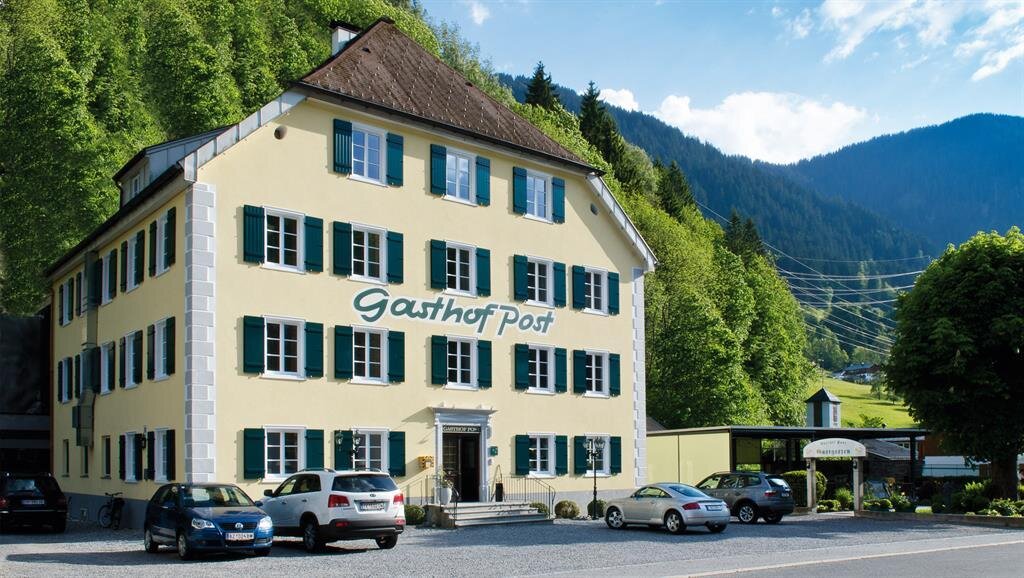
As early as the 17th century, there was an inn on this site, and Johann Christian von Strolz, the founder of the Holy Cross Church across the street, was a native of this town. With the expansion of traffic through the Arlberg, the “Schwarze Adler” gained increasing importance in the 19th century. As a post station—where even the emperor himself stayed overnight in 1881—the inn was eventually renamed “Post.”
The stately Gasthof Post in Dalaas is an important historical landmark in the history of travel across the Arlberg. As the most significant building in Dalaas, it was assigned the number 1 when house numbers were first introduced at the end of the 18th century. The Bavarian land registry of 1808 lists “a residential building along with two special stables,” which were owned by Christian Tscholl. Even back then, this was an important stop along the road through the Klostertal valley.
An inn had already stood on this site in the 17th century. Johann Christian Strolz was born here in 1669, the son of the innkeeper couple Adam Strolz and Anna Maria Fritz. His career was highly unusual for someone from the Klostertal at that time. Apparently supported by an unknown patron, he was able to study at the University of Vienna, where he earned a doctorate in law . At the age of 44, he was appointed a court councilor in Prague by Emperor Charles VI. Starting in 1731, he served as director of the fiscal office—a position that would be called“minister of finance”today. For his services, he was elevated to the nobility and took the title“Knight of Strolz.” He died in Prague at the age of more than 80. In his will, he bequeathed generous donations to his hometown of Dalaas, which made possible the construction of the Church of the Holy Cross, complete with its own benefice.
In the 1820s, Matthäus Gottlieb Schwarzhans , a native of St. Jakob am Arlberg, appears as the innkeeper ofthe “Schwarzer Adler”(which was only later renamed “Post”) and as the imperial and royal postmaster. He was an enterprising businessman who was able to capitalize on the economic boom following the opening of the new Arlberg Road. In addition to his business in Dalaas, he also leased the “Bad Fohrenburg” in Bludenz-Hinterplärsch in 1826, for which he placed an advertisement in the Feldkircher Wochenblatt. After his death in 1828, his son Johann Josef Schwarzhans took over the business in Dalaas. In 1831, he had a washhouse built —which still stands today—with the technical report for the project written by none other than Alois Negrelli.
After Schwarzhans’s death, his heirs sold his stately estate in Dalaas in 1857 to Josef Andreas Rhomberg, an entrepreneur from Dornbirn, who from then on served as innkeeper and postmaster. The sales contract mentions the“Postwirthshaus.”It is not known exactly when the name was changed. The Rhomberg family remained in Dalaas until 1903; initially, the older son ran the inn at the Post, and he eventually sold the property to his brother Josef Andreas. In 1882, Rhomberg also distinguished himself in Dalaas as the initiator of the founding of a volunteer fire department. He eventually sold the inn to Karl Fritz due to his advancing age. Fritz served as mayor of Dalaas for four decades, which is why the municipal office was also housed in the inn for a long time.


Address
Gasthof Post | Dalaas
66 Klostertalerstraße
6752 Dalaas